Why Most AI Marketing Fails in India (And How to Make It Work)
03/06/2026
Start Listening
Why Most AI Marketing Fails in India (And How to Make It Work)
AI marketing is everywhere right now.Every agency claims to be “AI-powered.” Every founder wants AI-generated content. Every brand is experimenting with automation, chatbots, predictive analytics, and AI creatives.
Yet most businesses quietly admit something uncomfortable:
Their AI marketing isn’t delivering meaningful results.
Despite the hype, many campaigns feel repetitive, generic, emotionally flat, and disconnected from actual customers. Engagement drops. Conversion quality weakens. Brand recall disappears.
Ironically, India is one of the most optimistic AI-driven markets globally. According to GroupM TYNY Report and Adobe’s APAC AI ROI study, Indian businesses are seeing strong ROI potential from AI adoption, but they continue to struggle with fragmented data, weak personalization systems, and implementation gaps.
That’s where the real issue lies.
AI itself is not failing.
Most brands are simply using it the wrong way.
Modern businesses need to understand that AI is not a shortcut to great marketing. It is an amplifier. If your strategy is weak, AI scales weak marketing faster. If your brand lacks emotional clarity, AI produces more noise—not more impact.
Brands that understand this difference are winning. Others are flooding the internet with content nobody remembers.
At Bestow, we’ve seen a clear pattern emerging across Indian businesses: the brands succeeding with AI are the ones combining automation with human creativity, storytelling, strategy, and brand positioning.
Most AI-generated marketing looks efficient. Very little of it feels memorable.
If your brand wants growth without losing originality, strategy, or emotional connection,
Connect with our team at Bestow
The Biggest Problem: Brands Think AI Is a Replacement, Not a Tool
This is where most AI marketing collapses.
Many businesses assume AI can replace strategy, copywriting, design thinking, or audience understanding entirely.
So they automate everything:
Blog writing
Ad copy
Social media captions
Emails
Creatives
Video scripts
Customer communication
The result?
Everything starts sounding identical.
Consumers are now exposed to massive volumes of AI-generated content daily.They can instantly detect when something feels generic or emotionally empty.
AI can generate words.
It cannot automatically generate brand depth.
That’s why emotionally driven communication is becoming more valuable than ever.Brands that invest in authentic narratives and emotional positioning still outperform purely automated content systems.This is especially true in India, where trust, relatability, and cultural nuance strongly influence buying decisions.
This is exactly why strong brand storytelling with emotion is becoming a major differentiator in the AI era.
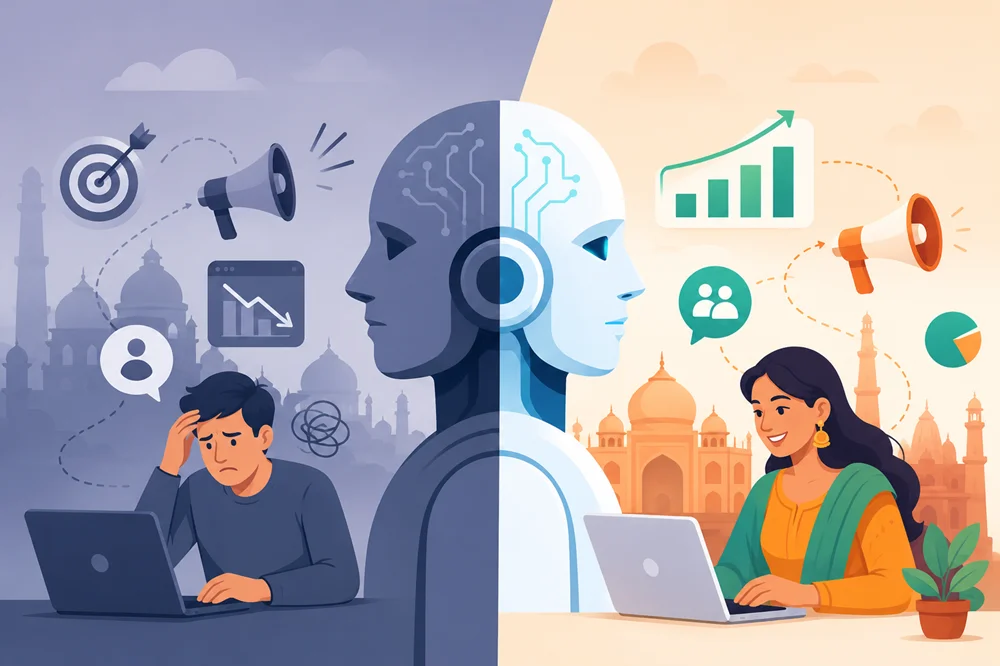
India’s AI Marketing Problem Is Also a Data Problem
Most Indian businesses are not truly data-ready.
AI marketing depends heavily on structured customer data, audience segmentation, behavioral insights, and platform integration.
But many brands still operate with:
Scattered CRM systems
Poor audience segmentation
Inconsistent analytics
No centralized customer journey tracking
Weak first-party data collection
So when they implement AI tools, the output becomes inaccurate or irrelevant.
AI is only as good as the information it receives.
If your customer data is fragmented, your personalization will fail.If your audience understanding is weak, AI-generated recommendations become random.
This explains why many businesses invest heavily in AI tools but still fail to improve engagement or conversions meaningfully.
The problem is not technology adoption.
The problem is strategic infrastructure.
Most AI Marketing in India Feels Fast — But Not Human
Speed has become overrated.
Yes, AI can create 50 captions in five minutes.It can generate ads instantly.It can automate customer responses at scale.
But consumers do not connect emotionally with efficiency alone.
People remember:
Stories
Emotions
Identity
Humor
Cultural relevance
Human insight
This is where many brands lose their uniqueness.
When everyone uses similar AI prompts, similar frameworks, and similar content structures, brands slowly become indistinguishable from one another.
The future of marketing will not belong to brands producing the most content.
It will belong to brands creating the most recognizable identity.
That’s why businesses must combine AI with strong creative direction, positioning, and differentiated messaging.
In fact, the gap between ordinary advertising and emotionally intelligent branding is becoming wider every year.
Brands now need to understand the difference between pure automation and meaningful creativity.
This is why approaches like creative vs traditional advertising are becoming central to modern brand strategy.
AI Works Best When Humans Stay in Control
The smartest brands are not removing humans from marketing.
They are removing repetitive work.
That distinction matters.
Winning businesses are using AI for:
Research acceleration
Data analysis
Content ideation
Workflow automation
Audience behavior prediction
Reporting
Personalization assistance
But humans still control:
Brand voice
Emotional positioning
Strategic direction
Storytelling
Campaign thinking
Creative execution
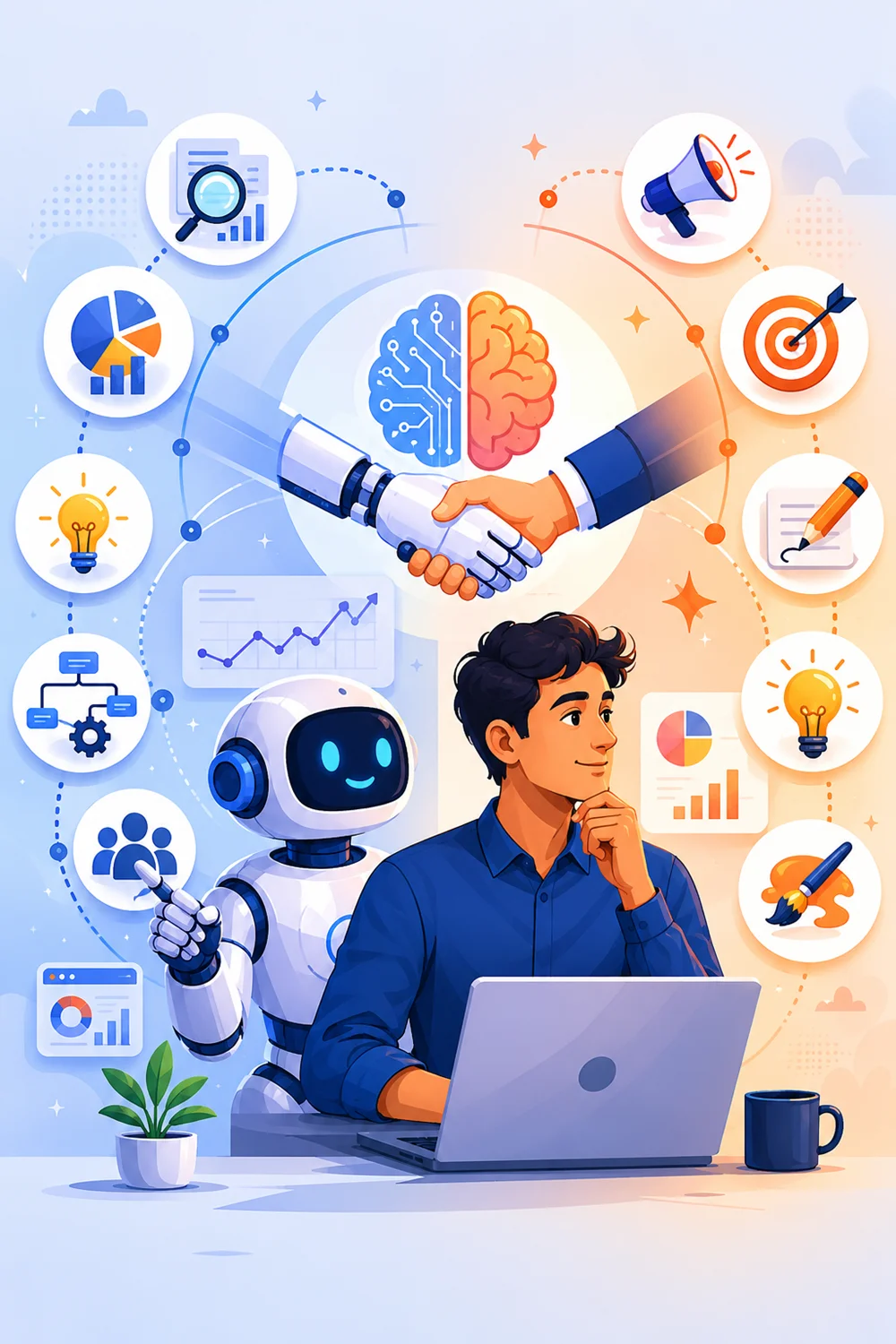
This hybrid approach is where the real results happen.
AI should improve decision-making — not replace thinking.
Indian Consumers Still Buy Emotionally
This is one reality many AI-first marketers forget.
Indian consumers are highly emotional decision-makers.
Trust, familiarity, social proof, relatability, and aspirational branding influence purchasing behavior far more than many brands realize.
People may discover products through AI-powered systems.
But they still buy because of emotional triggers.
That’s why engagement-focused marketing continues to matter deeply even in the AI era.
Brands that build communities, conversations, and emotional resonance consistently outperform brands relying only on automation.
Businesses that understand how to increase brand engagement are creating stronger long-term loyalty than businesses chasing pure AI-driven efficiency.
Most Businesses Adopt AI Before Fixing Their Brand
This is another hidden problem.
Many companies rush into AI tools before clarifying:
Their positioning
Their customer identity
Their messaging
Their tone
Their value proposition
Their visual consistency
So AI ends up amplifying confusion.
If your brand identity is unclear, AI cannot solve that problem.
Strong AI marketing only works when there is already strategic clarity underneath.
This applies even to digital experiences.
Many brands now automate website creation, but without proper user experience strategy, emotional design, or conversion thinking, the result feels generic and forgettable.
That’s why modern businesses must combine AI efficiency with intelligent design systems like the approaches discussed in website design trends in Vadodara.
The Future of AI Marketing in India Is Human-Led AI
The AI marketing race is entering a new phase now.
Initially, businesses competed on adoption.
Now they will compete on differentiation.
Soon, every company will have access to:
AI-generated content
AI-powered analytics
AI-driven ad optimization
AI automation workflows
AI creative tools
So technology alone will stop being a competitive advantage.
The real advantage will come from:
Better strategy
Stronger storytelling
Better emotional intelligence
Cultural relevance
Brand positioning
Human creativity
The brands that win in India will not be the ones using the most AI.
They will be the ones using AI most intelligently.
AI Is Powerful — But Strategy Still Wins
AI marketing is not a magic solution.
It is a multiplier.
If your brand already has:
Clear positioning
Strong messaging
Emotional storytelling
Audience understanding
Creative direction
Smart engagement systems
AI can dramatically accelerate growth.
But if those fundamentals are weak, AI simply scales mediocrity faster.
That’s why the future belongs to brands that balance automation with human insight.
At Bestow, we believe the strongest marketing systems in 2026 will combine AI efficiency with creativity, psychology, storytelling, and strategy — not replace them.
Your audience does not remember brands because they used AI.
They remember brands because they felt something.
If you want AI-powered marketing that still feels authentic, strategic, and emotionally engaging, connect with Bestow today and let’s plan your content strategy.
Connect with Bestow today
FAQs
AI marketing usually fails because businesses rely too heavily on automation without building strong strategy, storytelling, or customer understanding first. AI can generate content quickly, but without emotional relevance and clear positioning, the marketing feels generic and ineffective.
Yes, AI marketing can be extremely useful for Indian businesses when implemented strategically. It helps improve efficiency, personalization, analytics, automation, and campaign optimization, especially when combined with strong creative direction and audience insights.
Some popular AI marketing tools include ChatGPT, Jasper, HubSpot AI, Canva AI, Midjourney, Adobe Firefly, and Google Gemini tools. However, the best results come not from the tool itself, but from how businesses integrate it into their overall marketing strategy.
Businesses should use AI to automate repetitive tasks, analyze data faster, improve personalization, and support content creation — while keeping humans involved in strategy, storytelling, creativity, and brand voice. The best approach is human-led AI marketing, not fully automated marketing.
Categories
Recent Blogs
Send us a message
We'd love to hear from you
Let's build a plateform that works for you busines and the advertisers who trust it.
Talk to Our Expert