Brand Mentions vs Backlinks: What Builds Authority in the AI Era?
25/11/2026
Start Listening
Brand Mentions vs Backlinks: What Builds Authority in the AI Era?
For years, backlinks were considered one of the strongest indicators of website authority. The more credible websites linking to yours, the better your chances of performing well in search results.
But the way people discover brands is changing.
Today, consumers ask ChatGPT for product recommendations, use Google's AI Overviews to compare services, and consult Gemini before making purchasing decisions. These platforms can introduce brands without requiring users to click a traditional search result.
This raises an important question: Brand mentions vs backlinks—which contributes more to authority in an AI-driven search environment?
The answer isn't as simple as choosing one over the other. Backlinks remain valuable for SEO, while credible brand mentions can support recognition, reputation, and discoverability.
Understanding how these signals work together is becoming essential for businesses that want to remain visible.
At Bestow, we help businesses strengthen their digital presence through SEO, content strategy, and AI-focused optimisation. Connect with our experts to build a visibility strategy that goes beyond traditional rankings.
Get in touch with the usBrand Mentions vs Backlinks: Understanding the Difference
Although both contribute to a brand's online presence, they work differently.
What Is a Backlink?
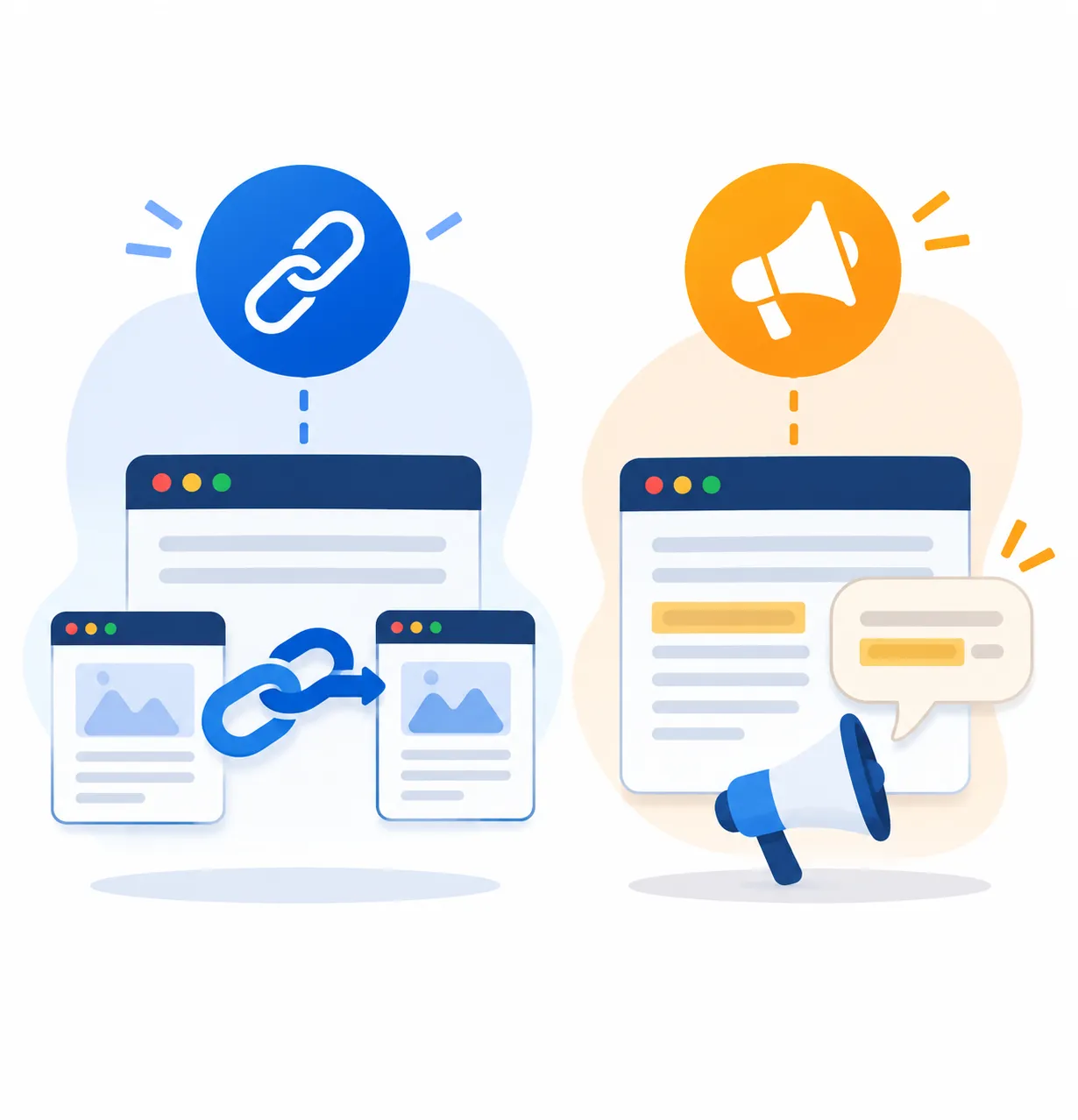
A backlink is a clickable link from another website directing users to yours.
For example, when an industry publication links to your research article, that link can help search engines discover the page and evaluate its relevance.
Backlinks can contribute to:
Search engine rankings and link equity
Website discovery and crawling
Referral traffic from relevant audiences
Credibility through editorial endorsements
However, quality matters more than quantity. A relevant editorial backlink from a reputable publication is generally more valuable than numerous links from unrelated websites.
What Is a Brand Mention?
A brand mention occurs when a website, publication, forum, or online community refers to your business, with or without a clickable link.
For example, an industry article might recommend a marketing agency by name without linking to its website.
Such references can contribute to brand awareness, credibility, and recognition across digital platforms.
The discussion around unlinked brand mentions SEO focuses on whether these references influence search visibility, even when no link equity is passed.
While their direct ranking impact remains uncertain, they can still create valuable opportunities for discovery and reputation building.
Do Backlinks Still Matter in 2026?
Absolutely.
Despite the growing popularity of AI-powered discovery, backlinks remain relevant to traditional search engine optimisation.
Google's ranking systems still use links to help understand pages and their relationships, although links are only one part of a much broader ranking framework.
Why Quality Backlinks Remain Valuable
Strong backlinks can:
Support authority: Editorial links from credible sources provide useful relevance and reputation signals.
Improve discoverability: Links help search engines find and understand interconnected content.
Generate qualified traffic: Relevant publications can send visitors who are genuinely interested in your services.
Strengthen content visibility: High-quality resources may attract links that support their performance in organic search.
However, the question do backlinks still matter in 2026 should not lead marketers to pursue links indiscriminately.
Google's spam policies discourage manipulative link schemes, including buying links primarily to influence rankings.
Businesses should instead prioritise relevant, editorially earned links and content worth referencing.
For a broader understanding of evolving ranking priorities, explore our guide to Google algorithm updates in 2026.
Why Brand Mentions Are Becoming Important in AI Search
Traditional SEO focuses heavily on making individual webpages discoverable and competitive.
AI-driven discovery introduces another consideration: whether a brand is sufficiently recognisable, relevant, and credible to appear in generated responses.
1. AI Systems Can Surface Brands Without Linking to Them
When someone asks an AI assistant to recommend software, agencies, or products, the response may name several brands.
Not every recommendation necessarily includes a direct website link.
This creates an additional visibility opportunity: being recognised as a relevant brand within a particular category.
However, an AI mention does not automatically prove that the system considers the brand authoritative.
2. Consistent References Can Reinforce Brand Recognition
When credible publications, industry experts, and relevant communities repeatedly discuss a business, they create a stronger public information footprint.
This matters for brand authority in AI search, where accurate, consistent information can help systems identify and contextualise businesses.
For example, a SaaS company featured in reputable industry comparisons, expert interviews, and independent reviews may become easier to associate with its category.
The value comes from credible context, not simply repeating the brand name across hundreds of websites.
3. Context Matters as Much as Visibility
Consider two mentions:
"ABC Software is one of several project management platforms."
"ABC Software offers workflow automation designed for distributed marketing teams."
The second provides more information about the company's offering and target audience.
This illustrates the importance of entity SEO: helping search systems understand what a business does, whom it serves, and which topics it relates to.
Related concepts such as co-citation and topical authority can help marketers think about these relationships, although neither guarantees inclusion in AI responses.
Link Building vs Digital PR: Which Strategy Should Brands Prioritise?
The discussion around link building vs digital PR reflects a broader shift in how businesses approach off-page visibility.
Traditional link-building campaigns often focus on acquiring backlinks from relevant domains.
Digital PR takes a wider approach by earning editorial coverage, expert commentary, interviews, industry recognition, and valuable brand exposure.
| Traditional Link Building | Digital PR |
|---|---|
| Primarily seeks relevant backlinks | Seeks editorial coverage and brand visibility |
| Often measures referring domains | Measures coverage, mentions, links, and reach |
| Supports organic search performance | Supports awareness, credibility, and discovery |
| Focuses on link opportunities | Focuses on newsworthy stories and expertise |
Neither approach should operate in isolation.
A strong digital PR campaign might earn a backlink from a respected publication while generating additional unlinked mentions across industry discussions.
The best outcome is not necessarily a link or a mention. It is credible coverage that reaches the right audience and reinforces what your brand is known for.
How to Build Authority Across Google and AI Platforms
Businesses need an integrated approach to off-page SEO for AI era visibility rather than relying on one metric.
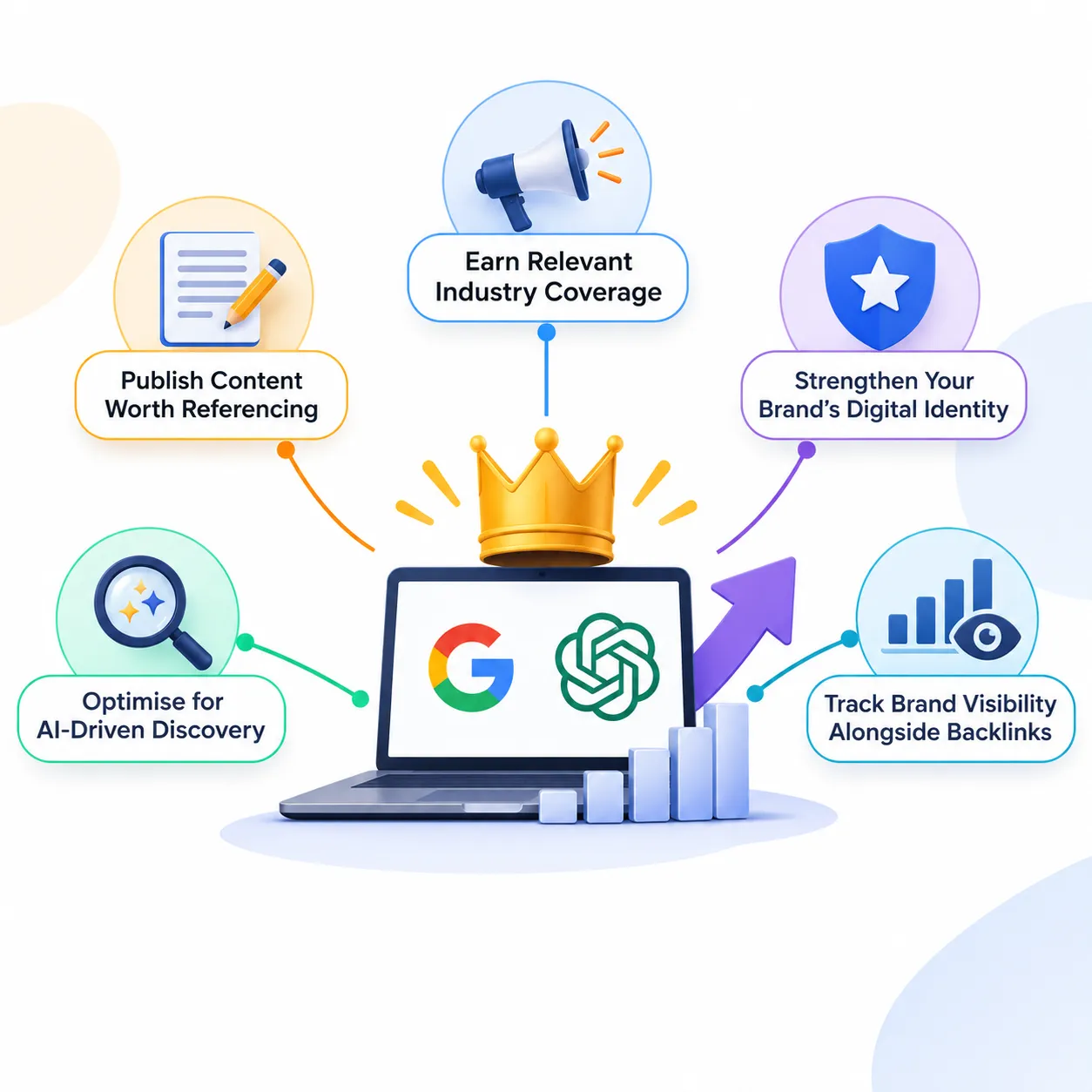
Here are five practical priorities.
1. Publish Content Worth Referencing
Original research, detailed guides, expert insights, and useful industry resources create reasons for other websites to reference your business.
Prioritise content that offers genuine value rather than repeating information already available everywhere.
2. Earn Relevant Industry Coverage
Contribute expert opinions to reputable publications, participate in industry discussions, and develop relationships with journalists.
Focus on editorial relevance instead of chasing high domain authority scores alone.
3. Strengthen Your Brand's Digital Identity
Maintain consistent business information across your website, professional profiles, relevant directories, and credible third-party sources.
Clear service descriptions, author credentials, and verifiable expertise can also support the trust-related principles reflected in Google's E-E-A-T framework.
4. Optimise for AI-Driven Discovery
Structure content around genuine customer questions, provide direct answers, and make important information easy to understand.
Bestow's AI-powered SEO approach helps businesses connect conventional search optimisation with evolving discovery experiences.
Our guide on GEO vs SEO explains how these disciplines differ and complement one another.
5. Track Brand Visibility Alongside Backlinks
Expand reporting beyond rankings and referring domains.
Monitor:
Quality backlinks and relevant referral traffic
Linked and unlinked brand mentions
Branded search demand
Relevant third-party editorial coverage
AI-generated brand mentions and LLM citations
AI visibility measurements should be treated as directional indicators because responses can vary across prompts, platforms, and time.
For more on this approach, read GEO Is the New SEO.
Brand Mentions or Backlinks: What Should Your Business Invest In?
The strongest strategy combines both.
Backlinks help support website-level search performance, while credible brand references can strengthen awareness and establish useful associations between your business and its industry.
Neither guarantees AI recommendations.
Businesses should invest in helpful content, genuine expertise, relevant editorial relationships, and consistent brand positioning.
Instead of asking which signal matters more, ask:
Is our brand visible, credible, and relevant wherever customers research their next decision?
That is the more useful question for modern search marketing.
The Future of Authority Is Bigger Than a Backlink
Search visibility is no longer limited to appearing among ten blue links.
Customers discover businesses through search engines, AI assistants, industry publications, online communities, and recommendations.
Backlinks remain an important SEO asset. Brand mentions add another dimension by supporting awareness and contextual recognition.
Businesses that combine technical optimisation, credible content, and earned industry exposure will be better positioned to compete across these channels.
Ready to strengthen your brand's digital authority?
At Bestow, we combine SEO, content marketing, and GEO services to help businesses improve their discoverability across traditional and AI-driven search.
Connect with usFAQs
A brand mention refers to a business by name, while a backlink is a clickable link directing users to its website.
They can support brand awareness and discovery, but there is no established evidence that every unlinked mention directly improves Google rankings.
Yes. Relevant, editorially earned backlinks remain useful for search visibility, website discovery, and referral traffic.
Their responses depend on factors such as the user's prompt, model knowledge, available retrieved information, and system-specific processes; neither platform publishes a complete brand-selection formula.
Both can contribute to a brand's wider digital presence, but there is no universal evidence that one consistently outweighs the other in AI-generated recommendations.
Google has not established that ordinary unlinked brand mentions function as a direct ranking signal equivalent to backlinks.
Use Google Alerts, brand-monitoring platforms, and SEO tools to identify references to your company that do not contain website links.
Contact the publisher politely, thank them for mentioning your brand, and suggest adding a relevant link where it genuinely benefits readers.
No. Combine ethical link building with digital PR, useful content, and credible brand exposure to support both traditional search and AI-era discoverability.
Categories
Recent Blogs
Send us a message
We'd love to hear from you
Let's build a plateform that works for you busines and the advertisers who trust it.
Talk to Our Expert